
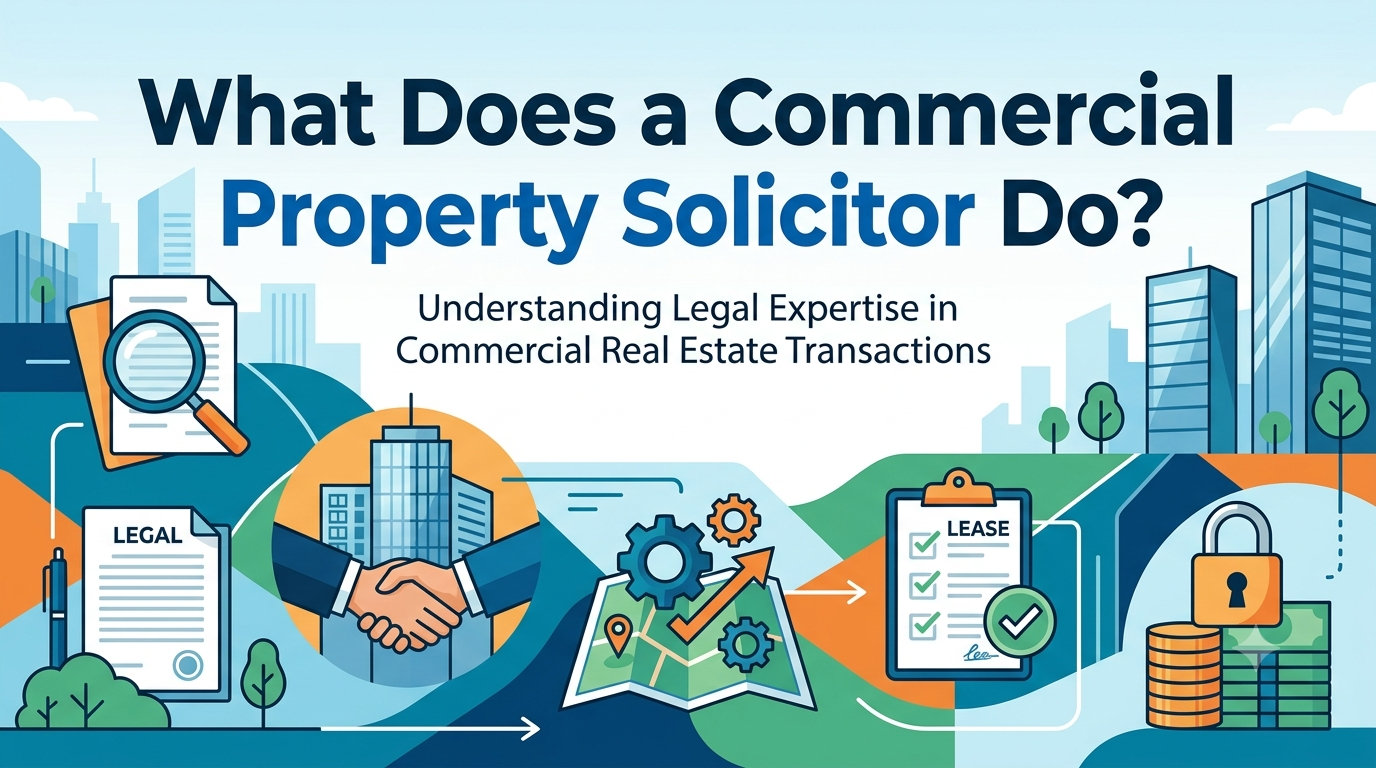
What Does a Commercial Property Solicitor Do

2 July 2026
A commercial property solicitor sorts out the legal side of property that businesses use. Offices, shops, warehouses, industrial units, development land. If money is changing hands and the property involved is not someone’s home, a commercial property solicitor is almost certainly involved somewhere in the transaction.
That is the simple version. The fuller picture is a bit more interesting, and if you are about to sign a lease, buy business premises, or develop a site, it is worth understanding properly.
Key Takeaways
Commercial property solicitors cover a wide range of work including purchases, sales, leases, development agreements and refinancing.
Their job is not just drafting documents. It is spotting problems before they cost you money.
Commercial property lease solicitors specifically handle the legal side of lease agreements, acting for either landlords or tenants but never both.
Getting a solicitor involved early, before you have agreed anything, puts you in a much stronger position.
The terms in a commercial lease can follow a business for ten or twenty years. That is not a document to sign without proper advice.
Why Commercial Property Law Is Nothing Like Buying a House
People sometimes assume that commercial property transactions work roughly the same way as buying a home, just with bigger numbers involved. That assumption tends to get expensive.
Residential conveyancing follows a fairly predictable path. There are standard forms, standard searches, and standard timescales. Most solicitors who handle residential work could walk through a straightforward purchase in their sleep.
Commercial property is different in almost every respect. There is no standard contract. Every deal is negotiated from scratch. The legal documents involved can run to hundreds of pages. And the implications of getting the terms wrong are not just inconvenient; they can fundamentally damage a business.
A company that signs a lease on a commercial unit without understanding the repairing obligations, for example, might later find itself legally responsible for the cost of replacing a roof it never knew it was responsible for maintaining. That is not a hypothetical scenario. It is the kind of thing that commercial property solicitors prevent and the kind of thing that happens when they are not involved.
What Commercial Property Solicitors Actually Spend Their Time On
The scope of this work is broader than most people realise. Here is an honest breakdown.
Buying and Selling Commercial Buildings
When a business buys a commercial property, the solicitor investigates the title. That means going through the land registry records, checking who actually owns the property, looking for any restrictions on what the land can be used for, and making sure there are no legal problems hiding behind what looks like a clean sale.
They carry out searches with the local authority, environmental agencies and other bodies. These searches can reveal things like planning enforcement notices, flood risk, contaminated land history or proposed road changes nearby. None of these will come up in a conversation with the estate agent.
They also handle the actual transfer of ownership, deal with Stamp Duty Land Tax, and register the new owner at the Land Registry once completion has taken place.
On the selling side, the solicitor prepares the contract pack, fields questions from the buyer’s legal team, and works to keep the transaction moving without unnecessary delays.
Both sides need their own solicitors. That is not optional, and it is not just a formality. The buyer and seller have directly opposing interests. One solicitor cannot properly serve both.
Lease Negotiations and Drafting
This is probably the area where commercial property solicitors add the most visible value for everyday business owners, and it is where commercial property lease solicitors do a significant portion of their work.
A commercial lease is not a standard document. It is a negotiation. The first draft almost always comes from the landlord’s solicitor, written in a way that protects the landlord’s interests. That is entirely appropriate. But it means the tenant needs someone in their corner who knows how to read that document critically and push back on the terms that are unfair or unreasonable.
Lease length matters. Break clauses matter enormously. The rent review mechanism, whether that is upward only or linked to an index, can make a very significant difference to what a tenant pays over the life of the lease. Service charge provisions can be vague in ways that end up being very expensive. Dilapidations obligations at the end of a lease, meaning what the tenant has to pay to restore the property to its original condition, can result in bills that catch tenants completely off guard.
Commercial property lease solicitors go through all of this. They negotiate the terms that can be negotiated. They explain clearly what the terms mean in practice. And they make sure that before anyone signs anything, both sides genuinely understand what they have agreed to.
Acting Separately for Landlords and Tenants
This point is worth being clear about because it surprises some people.
Commercial property lease solicitors act for one party in a lease transaction. Either the landlord or the tenant. Not both.
This is not just a professional convention. It reflects the reality that landlords and tenants want different things from a lease. A landlord wants the tenant locked in for as long as possible, responsible for as much of the property maintenance as possible, and with as little flexibility to exit as possible. A tenant wants the opposite. One solicitor cannot honestly serve both of those positions at the same time.
If anyone suggests that the same solicitor can represent both sides in a commercial lease negotiation, that is a serious red flag.
Development Work
Commercial property solicitors also work heavily in the development space. This covers option agreements, which allow a developer to secure land while planning permission is being sought without having to buy it outright, as well as promotion agreements, overage provisions and joint venture structures between landowners and developers.
Planning law feeds into this work too, particularly when it comes to Section 106 agreements, which are legal obligations attached to planning permissions that require developers to contribute to local infrastructure or affordable housing.
Development transactions can involve a lot of moving parts and a lot of money. The legal framework needs to be right from the start because unpicking poorly drafted development agreements midway through a project is expensive and sometimes impossible.
Refinancing and Secured Lending
Many businesses borrow against their commercial property. When they do, the lender will carry out their own legal due diligence on the property being used as security. The borrower needs their own solicitor to review the security documents and advise on what they are actually agreeing to.
This is an area where commercial property solicitors work closely with finance teams and lenders. Timescales are often tight, and the documentation involved is technical. Having a solicitor who is experienced in this type of work means the transaction moves efficiently rather than stalling on legal queries.
The Practical Difference Good Legal Advice Makes
There is a version of this that sounds like standard professional services marketing: instruct a solicitor and everything goes smoothly. The reality is more specific than that.
Good commercial property solicitors find things. During a title investigation, they might uncover a restrictive covenant that prevents the buyer from using the property for retail purposes, which would be a significant problem if the buyer intends to open a shop. They might identify that planning consent for an extension was never formally signed off, creating a potential enforcement risk for the new owner.
In lease negotiations, experienced commercial property lease solicitors push back on provisions that less experienced advisors might let slide. Upward-only rent reviews used to be standard in commercial leases. They still appear frequently. A solicitor acting for a tenant will always try to negotiate a more balanced mechanism. Whether they succeed depends on the bargaining position of the parties, but the attempt needs to be made.
The absence of a solicitor does not mean these problems disappear. It means the client discovers them later, usually when they are harder and more expensive to resolve.
When Is the Right Time to Get a Commercial Property Solicitor Involved
Earlier than most people think.
The most common mistake is waiting until heads of terms have been agreed and then bringing in a solicitor to document what has already been decided commercially. By that point, the leverage to negotiate key legal points has largely gone.
If you bring in commercial property solicitors before heads of terms are finalised, they can advise on what provisions to include, what to be cautious about, and what concessions are worth pushing for while you still have room to push. That changes the outcome of the transaction in ways that matter.
The same applies to lease renewals. If your lease is coming up for renewal, speaking to commercial property lease solicitors several months before the expiry date gives you time to negotiate properly. Waiting until the last minute tends to result in accepting terms you would rather not have.
Conclusion
Commercial property solicitors are not just a legal formality. They are the people who make sure you actually understand what you are getting into before you commit to it.
Whether you are buying premises for your business, negotiating a lease as a landlord or tenant, refinancing against commercial real estate, or developing land, the quality of your legal advice shapes the outcome directly.
Commercial property lease solicitors, in particular, do work that has consequences stretching across years or decades. A lease signed today might still be running in 2040. The terms agreed now will determine the financial obligations your business carries for all of that time.
If you are dealing with any commercial property matter, the right move is to speak to experienced commercial property solicitors before you make commitments, not after.
Frequently Asked Questions
What does a commercial property solicitor do?
They handle the legal work involved in buying, selling, leasing and developing property used for business purposes. This includes title investigations, contract drafting, lease negotiations, planning agreements and refinancing support.
Do I need a solicitor to sign a commercial lease?
Yes, and it matters that you instruct commercial property lease solicitors before you sign, not after. The first draft of any lease is written to protect the landlord. You need someone reviewing it in your interests before you commit.
Can one solicitor act for both the landlord and the tenant?
No. Commercial property lease solicitors must represent one party only. Landlords and tenants have opposing interests in any lease negotiation, and both sides need independent legal advice.
How is commercial property law different from residential conveyancing?
Commercial transactions involve bespoke contracts, complex lease structures, planning considerations, VAT implications and much larger financial stakes. There is no standard form and no predictable process in the way residential conveyancing has.
When should I instruct a commercial property solicitor?
Before you agree to anything, if possible. Getting commercial property solicitors involved before heads of terms are signed gives them the best opportunity to shape the deal in your favour and identify issues before they become expensive problems.