
Residential vs Commercial Conveyancing: What Is the Difference

2 July 2026
Residential conveyancing deals with the legal transfer of homes, flats and private dwellings. Commercial conveyancing covers property used for business purposes, such as offices, retail units, warehouses and development land. Both involve transferring legal ownership from one party to another, but the processes, timescales, documents and risks involved are genuinely quite different.
If you are trying to work out which type of solicitor you need, or simply want to understand why commercial transactions tend to take longer and cost more, this guide covers everything you need to know.
Key Takeaways
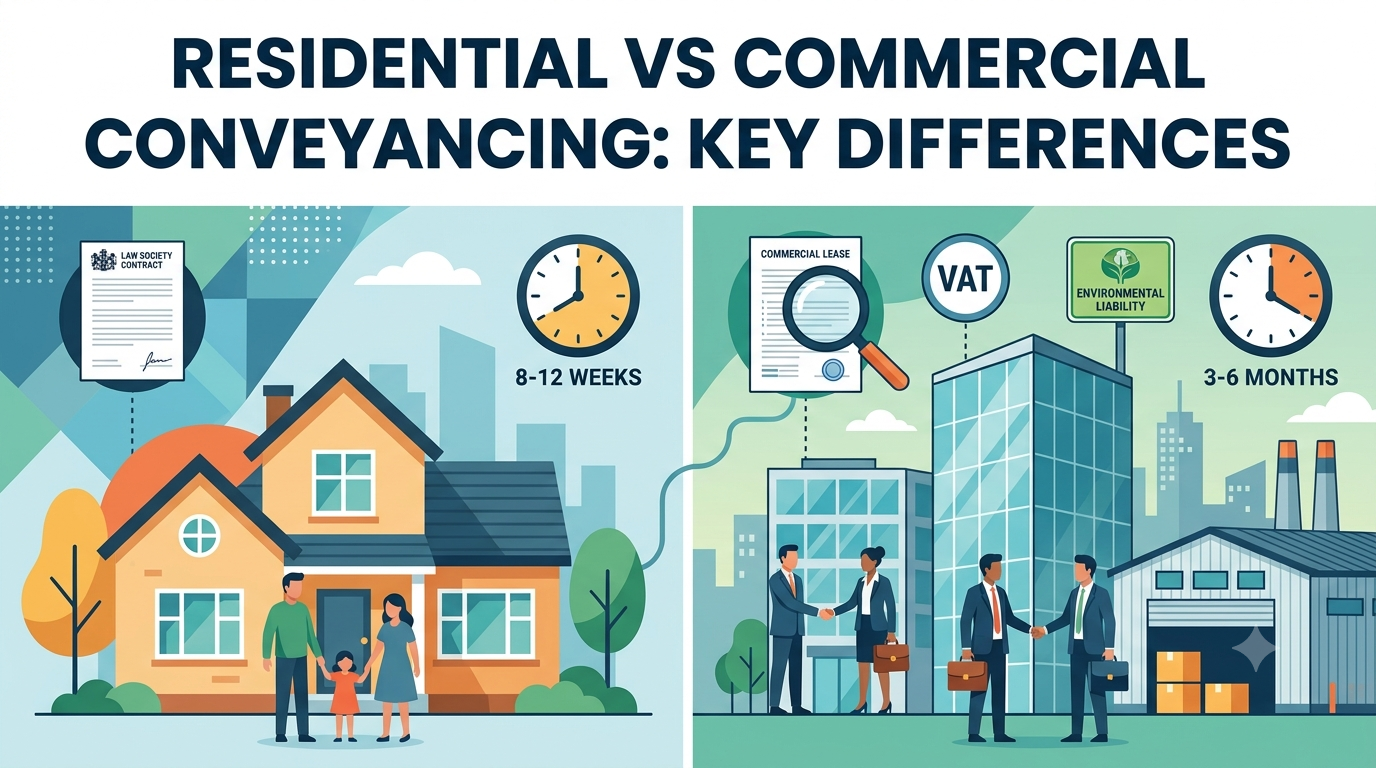
Residential conveyancing follows a relatively predictable process with standard forms and typical timescales of eight to twelve weeks.
Commercial conveyancing is bespoke. Every transaction is negotiated from scratch and can involve planning law, VAT, environmental liability and complex lease structures.
Residential property solicitors handle homes and flats. Commercial property solicitors handle business premises and investment property.
Commercial transactions almost always take longer and involve more legal complexity than residential ones.
Both types of conveyancing require independent legal advice for each party involved in the transaction.
What Is Conveyancing and Why Does It Matter
Conveyancing is the legal process of transferring ownership of property from one person or entity to another. It covers everything from investigating the title to the property through to completing the transfer and registering the new owner at the Land Registry.
Without conveyancing, property transactions would carry enormous legal risk. A buyer could purchase a property only to discover later that the seller did not have the legal right to sell it, or that there are legal restrictions on what the property can be used for, or that a third party has a financial charge registered against the title.
Conveyancing is the process that prevents those situations from arising. And whether you are buying a three-bedroom semi or acquiring a warehouse on an industrial estate, getting that legal work right is not optional.
How Residential Conveyancing Works
Residential conveyancing is the process most people are already familiar with, even if only from their own experience of buying or selling a home.
The Typical Residential Transaction Process
When someone agrees to buy a home, both parties instruct their own solicitors. The seller’s solicitor prepares the contract pack, which includes the title deeds, property information forms, fixtures and fittings details and any relevant certificates or guarantees for work carried out on the property.
The buyer’s solicitor reviews all of that material, raises any questions, carries out searches with the local authority and other bodies, and reports to the buyer on what has been found. Once everyone is satisfied, contracts are exchanged. At that point, both parties are legally committed to the transaction. Completion follows, usually a couple of weeks later, when the money is transferred and the keys change hands.
The whole process typically takes between eight and twelve weeks for a standard residential purchase, though chains can extend that considerably.
What Residential Property Solicitors Look For
Residential property solicitors are checking for a fairly defined set of things. Is the title clean and unencumbered? Are there any restrictions on the property that would affect how the buyer can use it? Do the searches reveal any planning enforcement notices, flood risk or proposed developments nearby? Is the seller actually entitled to sell?
For leasehold properties, which make up a large proportion of flats sold in England and Wales, there is additional work involved. The lease itself needs to be reviewed, along with service charge accounts, the management company’s accounts, and information about any planned major works that could result in significant bills for the new owner.
Residential property solicitors tend to work with standardised forms and relatively predictable documentation. That does not mean the work is simple, but it does mean experienced solicitors can move through it efficiently.
How Commercial Conveyancing Works
Commercial conveyancing starts from a completely different position. There is no standard process, no standard contract, and no set list of documents. Every transaction is built from scratch based on the specific property, the specific parties, and the specific deal that has been agreed.
The Scope of a Commercial Transaction
When a business buys a commercial property, the legal due diligence required is considerably broader than in a residential transaction. The solicitor needs to investigate the title, review any existing leases if the property is tenanted, consider the planning history and any conditions attached to planning consents, look at environmental risks including contaminated land, consider VAT implications, and check whether any restrictions affect how the buyer intends to use the property.
Commercial property solicitors also deal with the financing structure of the transaction. Lenders who provide commercial mortgages carry out their own legal due diligence, and the borrower’s solicitor needs to review and advise on the security documents before anything is signed.
All of this takes time. A commercial purchase can take anywhere from three months to considerably longer, depending on the complexity involved.
Lease Negotiations in Commercial Property
One of the biggest differences between residential and commercial conveyancing is the role that leases play on the commercial side.
In residential transactions, most purchases involve freehold property or standard long leases. The lease terms are relatively fixed and governed by residential landlord and tenant law.
In commercial transactions, leases are entirely negotiated documents. The length of the lease, the rent and how it is reviewed, the service charge structure, the repairing obligations, break clauses and what happens at the end of the lease are all points of negotiation between the parties.
Commercial property solicitors acting for tenants push hard on these terms because they will govern the financial obligations of the business for years, sometimes decades. A poorly negotiated commercial lease can leave a tenant responsible for repair costs they did not anticipate, locked in for longer than their business needs, or facing a substantial dilapidations bill when they eventually vacate.
What Are the Key Differences Between the Two
It helps to look at the main differences side by side, even in descriptive terms.
Complexity and Bespoke Documentation
Residential conveyancing uses standard Law Society forms and follows a broadly consistent structure. Commercial conveyancing uses bespoke documentation throughout. Every contract, every lease, every ancillary agreement is drafted specifically for the transaction in hand.
This is one reason why commercial legal fees tend to be higher than residential ones. The work involved is genuinely more complex and more time-consuming.
Timescales
A residential purchase in a chain-free situation can move from offer to completion in six to eight weeks if everything goes smoothly. Commercial transactions rarely move that quickly. Three to six months is more typical for a straightforward commercial purchase, and transactions involving development land, complex title issues or multiple parties can take considerably longer.
VAT Considerations
Residential property is generally exempt from VAT. Commercial property is more complicated. Sellers can opt to charge VAT on commercial property transactions in certain circumstances, and buyers need to understand the VAT implications before they complete. This is an area where residential conveyancing simply does not apply, and it is one of several reasons why commercial property solicitors need a broader technical skill set.
Environmental and Planning Issues
Commercial properties, particularly industrial sites and development land, carry environmental risks that rarely arise in residential transactions. Contaminated land liability, for example, can fall on the current owner of a site even if the contamination occurred under a previous owner. Commercial property solicitors routinely consider environmental search results and advise clients on whether specialist environmental reports are needed.
Planning law is also far more significant in commercial transactions. The permitted use of a commercial property is defined by its planning consent, and buying a property with the intention of using it for a purpose that planning does not allow for is a serious and costly mistake.
Do You Need Different Solicitors for Each Type
Yes. Residential property solicitors and commercial property solicitors are not interchangeable, even though both technically fall within the broader discipline of property law.
Solicitors who specialise in residential work are experts in the processes, forms and legal frameworks that govern homes and flats. They understand leasehold law as it applies to residential property, Help to Buy schemes, mortgage conditions from high street lenders and the practical pressures of managing a property chain.
Commercial property solicitors bring a different skill set. They understand commercial lease law, business rates, VAT on property transactions, development agreements, environmental liability and the kind of complex title issues that arise with commercial and industrial sites.
Trying to use a residential property solicitor for a complex commercial acquisition, or asking a commercial specialist to handle a standard home purchase, is possible in theory but rarely ideal in practice.
Which Type of Conveyancing Do You Need
If you are buying, selling or remortgaging a home, a flat or any property that will be used as a private residence, you need residential property solicitors.
If you are acquiring, selling, leasing or developing property that will be used for business purposes, you need commercial property solicitors. This applies whether you are a small business owner buying your first office, a landlord acquiring a retail unit, or an investor purchasing a portfolio of commercial properties.
Some transactions involve elements of both. A mixed-use building with residential flats above a commercial unit, for example, requires solicitors who are comfortable dealing with both sets of legal considerations. In those cases, it is worth checking that the firm you instruct has genuine experience across both areas.
Conclusion
Residential and commercial conveyancing share the same basic purpose, transferring legal ownership of property from one party to another, but that is roughly where the similarity ends.
Residential conveyancing follows a structured process, operates within a well-established legal framework, and typically moves to completion within a few months. Commercial conveyancing is bespoke from start to finish, involves a much wider range of legal considerations, and demands a broader technical skill set from the solicitors involved.
Knowing which type of legal support you need is the first step. After that, finding solicitors with genuine experience in that specific area of property law is what makes the difference between a transaction that goes smoothly and one that runs into problems.
Whether you are buying your first home or acquiring commercial premises for your business, instructing the right solicitors at the right stage of the process is one of the most straightforward and valuable decisions you can make.
Frequently Asked Questions
What is the difference between residential and commercial conveyancing?
Residential conveyancing handles the legal transfer of homes and flats, following a standardised process governed by residential property law. Commercial conveyancing covers business property and involves bespoke contracts, lease negotiations, VAT considerations and a much wider range of due diligence.
Do I need a specialist solicitor for commercial property?
Yes. Commercial property solicitors have a different skill set to residential specialists. Commercial transactions involve planning law, environmental liability, VAT and complex lease structures that require specific expertise.
How long does commercial conveyancing take compared to residential?
Residential conveyancing typically takes eight to twelve weeks for a standard transaction. Commercial conveyancing usually takes three to six months, and complex deals involving development land or multiple parties can take considerably longer.
Can the same solicitor handle both residential and commercial conveyancing?
Some solicitors work across both areas, but most firms specialise in one or the other. For any significant transaction, it is worth instructing solicitors with specific experience in the type of property you are dealing with.
What additional checks are done in commercial conveyancing?
Commercial property solicitors carry out environmental searches, review planning history and consents, investigate existing leases, consider VAT implications and examine any restrictions on the permitted use of the property. These checks go considerably beyond what is required in a standard residential purchase.